How model: "auto" decides: judge-based effort routing in 250 ms
Inside Keystone's auto-routing: how a decision model rates a prompt's difficulty, why it gets 250 ms, what happens when it is slow, and how to keep control with pinned efforts.
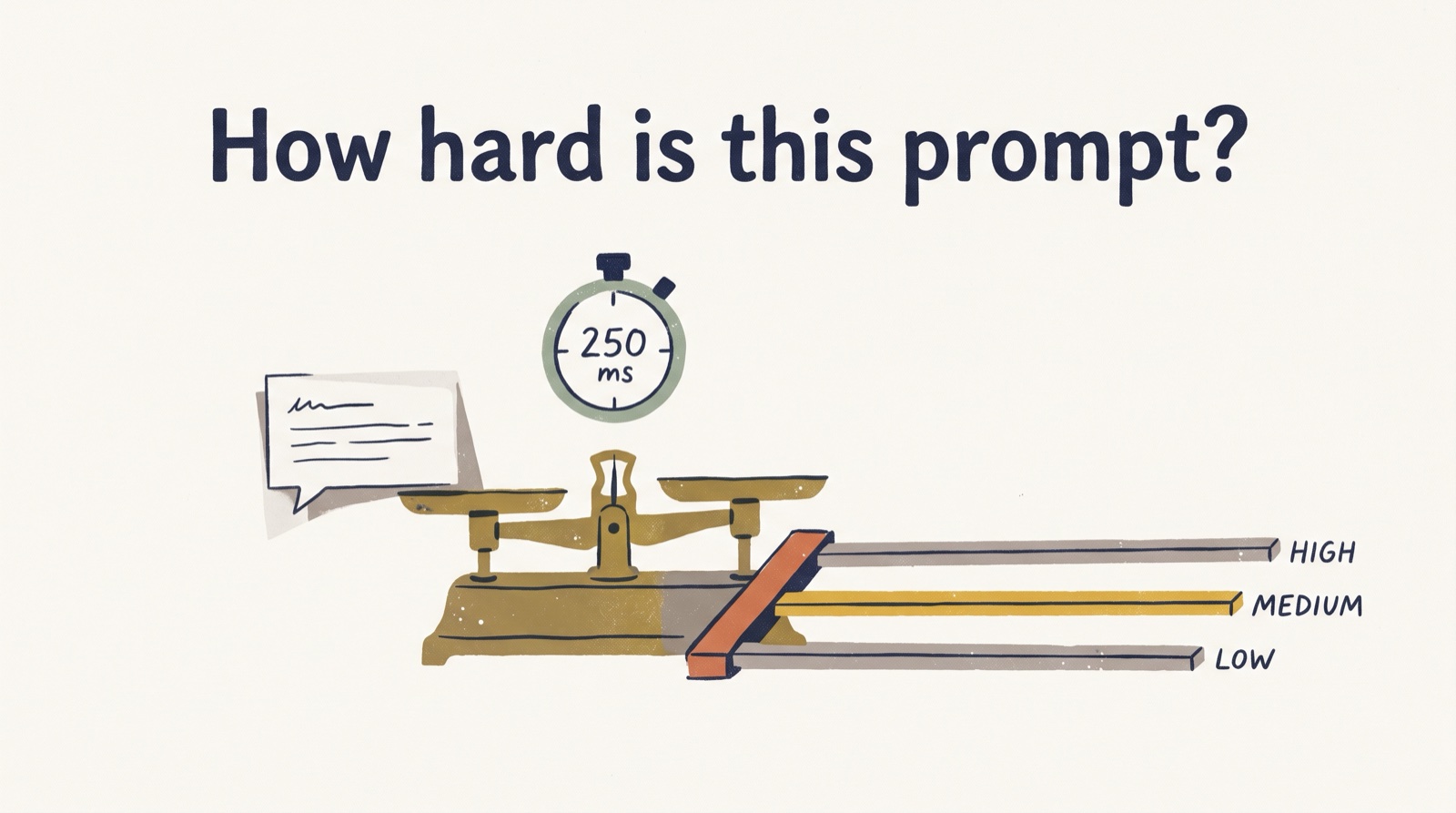
“What time is it?” and “prove that √2 is irrational” arrive in the same chat box, a minute apart. Send both to your best model and you overpay for the first. Send both to the cheap one and the second gets a confident wrong answer.
In Keystone. The Model Switchboard. (KTMS), a service never names a model. It asks for an effort,
LOW, MEDIUM or HIGH, and routing rules map that to a chain of models. That works when the
caller knows how hard its task is. A summarizer does. A chat box where users ask anything does not.
For that case there is model: "auto": a judge model rates the prompt in under 250 ms, and the
gateway routes on its answer. This post walks through what KTMS does with it, as of 1.3.
The order of precedence
Before any judge is called, Keystone checks whether the caller already decided:
- An effort pinned in the model name:
auto:low,auto:medium,auto:high, or combined with a placement such asauto:nodes-only:high. - The
reasoning_effortfield of the OpenAI request (low,medium,high). Over gRPC, the same thing isauto_routewitheffort_specified. - Only then a judge.
So an existing client that already sends reasoning_effort keeps full control, and the judge only
fills the gap.
What the judge is asked
The judge is a decision model, not a chat model. It doesn’t write text; it answers typed questions
with probabilities. KTMS supports TypeSafe’s Jev (jev-latest) and OpenAI Decisions
(gpt-6-luna) as judges.
KTMS builds the judge’s input from the request instruction and the user messages, including text parts of multimodal messages, trimmed to 4,000 characters. If guardrails masked personal data earlier in the request, the judge sees the masked text. The state is one JSON field:
{"prompt": "Explain the difference between MVCC in Postgres and Oracle"}
and the question is a single choice:
| Option | Description given to the judge |
|---|---|
low |
Simple, short, greeting, basic formatting, translation, or straightforward retrieval |
medium |
Standard instruction following, summary, general conversational chat, creative writing |
high |
Complex multi-step reasoning, mathematical proof or calculation, advanced programming/coding, deep technical analysis |
The judge returns the chosen option with its confidence. KTMS maps it to an effort and then routes exactly as if the caller had sent that effort: the same rules, the same fallback chain.
Why 250 ms, and what happens when it’s slow
The judge call has a hard deadline of 250 ms. A decision model typically answers well within that, and anything longer starts to eat into the user’s time to first token, which is the whole point of routing easy prompts to fast models.
When the judge misses the deadline, isn’t configured, or fails, KTMS does not drop the request and
does not return an error. It routes at MEDIUM and marks the response as auto-default. An empty
prompt goes to MEDIUM without asking anyone.
The judge call itself goes through the normal machinery: it is routed by a rule for the judge
modality, respects the judge model’s rate limit, and has its own circuit breaker, so a judge vendor
outage costs at most one deadline per request until the breaker opens, and then nothing.
Seeing what happened
Every response says how it was routed:
curl -si localhost:8080/v1/chat/completions \
  -H "Authorization: Bearer ktms_..." -H "Content-Type: application/json" \
  -d '{"model":"auto","messages":[{"role":"user","content":"Prove that sqrt(2) is irrational"}]}' \
  | grep -i '^x-ktms'
X-KTMS-Route-Mode: auto-judge
X-KTMS-Judge-Score: 0.93
X-KTMS-Judge-Model: jev-latest
X-KTMS-Rule: high-default
X-KTMS-Vendor: anthropic
(Example output: the score, rule and vendor depend on your models and rules.)
X-KTMS-Route-Mode is one of direct, override, auto-effort (effort pinned), auto-judge
(the judge chose) and auto-default (the judge didn’t answer, MEDIUM was used). Over gRPC the
same values are in route_mode, judge_score and judge_model on the response.
Setting it up
You need a judge model and a rule for the judge modality:
grpcurl -plaintext -H "authorization: Bearer $ADMIN_KEY" -d '{"model":{"id":"jev-latest",
  "vendor":"typesafe","capabilities":["judge"],"efforts":["EFFORT_LOW"],"enabled":true}}' \
  localhost:9090 ktms.v1.AdminService/UpsertModel
{"name":"judge", "priority":100, "attributes":{"modality":"judge"},
 "use":["jev-latest"], "enabled":true}
Add it to your rules with ReplaceRules (the whole set is replaced at once) and give the client
key a TypeSafe vendor key with SetVendorKey. Without a judge, model: "auto" still works: every
unpinned request simply goes out at MEDIUM.
Is it worth it?
Measure it on your traffic rather than trusting a blog post. The usage events KTMS sends carry the rule and model of every call, so you can compare cost and failure rates per effort before and after turning auto-routing on. Things to watch:
- Judge cost. TypeSafe bills input tokens only; OpenAI Decisions bills input and output.
- Misroutes. A hard prompt routed
LOWis worse than an easy prompt routedHIGH. Shadow traffic withshadow_evalcan compare a cheaper model’s answers with the primary’s in the background, without touching the user’s response. - Latency. The judge’s time is added before the model call. For streaming chat, check time to first token.
The honest part
The judge’s effort choice is marked Experimental in 1.x. It works and is supported, but the
question, the options and how the answer is mapped may change in a minor release, and the change
will be listed in the changelog. Auto-routing with a pinned effort (auto:high), placement policies
and model_override are stable.