The logs say 200: which model actually answered?
The model name in your code is a request, not a fact. How Keystone reports the model, vendor and rule that served each call, where that shows up (response, headers, usage events, metrics), and the one thing it cannot see.
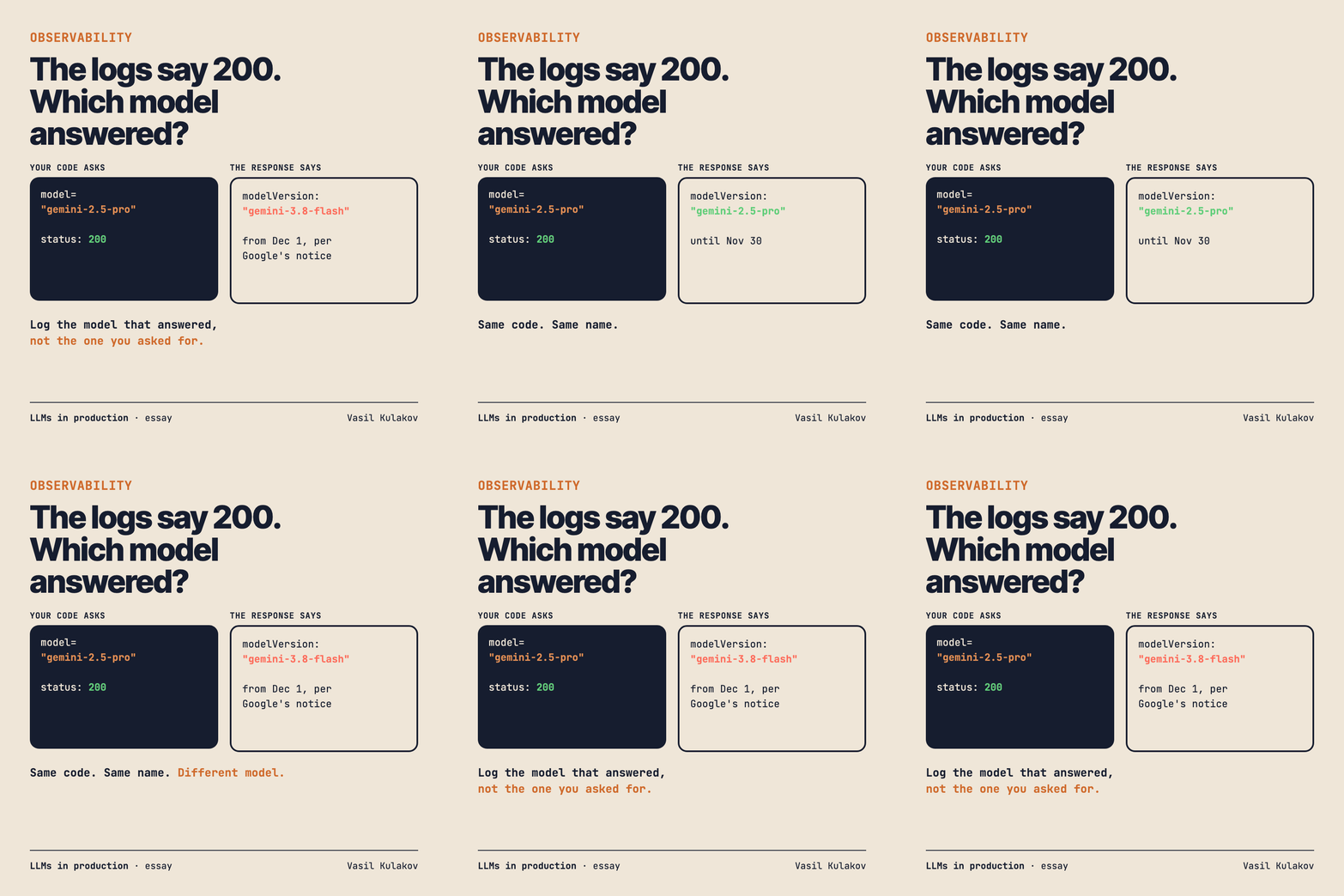
A user says the answers got worse last week. Your logs say every call returned 200, and your
code says model="gemini-2.5-pro". So everyone assumes that model answered. It may not have.
The name in your code is what you asked for. Between that request and the answer there can be a fallback chain, a router, a cache and the vendor’s own aliasing. Each of them can change who answers without changing the status code.
This post shows what Keystone. The Model Switchboard. (KTMS) records about the model that actually served a call, where you can read it, and where its knowledge stops.
Four ways the answer comes from somewhere else
- Fallback. A rule in Keystone is an ordered chain of models. If the first one is rate
limited, paused after a
Retry-After, behind an open circuit breaker or times out, the next one answers. The client still gets 200. - Routing. With
model: "auto", a judge picks the effort, and the effort picks the rule (how that works). Two identical-looking requests can land on different models by design. - Cache. With the cache on, an answer may be one that was stored earlier, from whichever model produced it then.
- The vendor. An alias such as
-latestis moved to new releases by the vendor. Google has also announced that from December 1, Gemini API requests forgemini-2.5-progo togemini-3.8-flash. Same code, same name, different model.
The first three happen inside the gateway, so the gateway can tell you about them. The fourth happens behind the vendor’s API, and that matters later in this post.
What the response tells you
On the OpenAI-compatible endpoint, the model field of a chat completion is not an echo of your
request. KTMS fills it with the registry model that served the call
(internal/server/openai.go):
writeJSON(w, http.StatusOK, map[string]any{
	"id": id, "object": "chat.completion", "created": created,
	"model": resp.ResolvedModel, "choices": choices, "usage": usage,
})
Streams carry it in every chunk the same way. The response headers say how the call got there:
| Header | What it holds |
|---|---|
X-KTMS-Vendor |
The vendor that served the call |
X-KTMS-Rule |
The routing rule that matched (empty with an exact model override) |
X-KTMS-Route-Mode |
direct, override, auto-judge, auto-default or auto-effort |
X-KTMS-Placement |
nodes_first, nodes_only, cloud_first or cloud_only |
X-KTMS-Judge-Model, X-KTMS-Judge-Score |
Which judge rated the prompt, and its score (experimental) |
X-KTMS-Cache |
HIT or MISS when the cache is on |
X-KTMS-Model |
The served model, on speech, image, embedding and decision endpoints |
Over gRPC the same facts are fields of GenerateTextResponse: resolved_model,
resolved_vendor, matched_rule, route_mode, placement, cached
(gateway.proto).
Every header is also sent under its old X-LLM-Proxy-* name until its announced Sunset date,
2027-03-01.
Take the example configuration from the repository: a rule high with the chain
[gpt-4o, gpt-4o-mini]. Ask for high effort while gpt-4o is rate limited:
curl -si localhost:8080/v1/chat/completions \
  -H "Authorization: Bearer ktms_<your key>" -H "Content-Type: application/json" \
  -d '{"model":"auto:high","messages":[{"role":"user","content":"Say hi"}]}' \
  | grep -iE '^x-ktms-|"model"'
The status is 200. The headers say X-KTMS-Rule: high, X-KTMS-Vendor: openai and
X-KTMS-Route-Mode: auto-effort, and the body’s model is gpt-4o-mini, the second link of the
chain. Without a gateway, the same outage looks like a 429 in one service’s logs, or like nothing
at all if your client library retries against another model on its own.
From a terminal, ktms chat "Say hi" sends one test call and prints the answer followed by the
rule, model and vendor that served it. Its source
(cmd/ktms/http_cmd.go)
is a short reference for reading these headers in your own client.
What the logs tell you, after the fact
A response header helps the caller. When a user complains a week later, you need history.
Usage events. Every upstream call goes through a tracking adapter that records a usage event
with the vendor and model of that call, its tokens, duration, cost and status
(tracking_adapter.go).
A failed call is recorded too, with status ERROR and no tokens. Vendor SDKs run with their own retries off, so one attempt is one vendor call,
and the router retries a 429 or 5xx once on the same model before it falls back. A fallback
therefore leaves a trail: error events for gpt-4o, then a success event for gpt-4o-mini, all
with the same rule and effort in their meta and the same attributes your service sent
(user_id, action_id, metadata). The events go to light-tokenmeter, where you can group them by model and day.
A cache hit is its own event: zero tokens, the vendor and model of the stored answer, and
cache=hit in its meta (cache_match=semantic and the similarity for a semantic hit). A drop in
quality that coincides with a rise in cache hits is a different problem from a model change, and
the events let you tell them apart.
Metrics. ktms_fallbacks_total{from_model, to_model, reason} counts every move down a chain.
The reason is cooldown, circuit_broken, upstream_timeout, content_filter,
capacity_exhausted or schema_failure. A graph of it per rule answers “how often did the second
model answer last week” without reading a single log line. ktms_requests_total carries vendor
and model labels on every upstream call.
Traces. Each upstream call is a span named after the model, with the OpenTelemetry
gen_ai.provider.name and gen_ai.request.model attributes and the KTMS rule.
Where the gateway’s knowledge stops
Here is the honest part. The model KTMS reports is the registry id it called. The registry id
is also the model name sent to the vendor
(internal/registry/build.go).
KTMS does not currently read the vendor’s own report of what answered, such as Gemini’s
modelVersion field. If the vendor redirects a name behind its API, Keystone reports the name it
asked for.
Two habits close most of that gap:
- Register pinned, dated model ids rather than moving aliases. If a registry id ends in
-latest, the model behind it changes on the vendor’s schedule, and every log line keeps the same name. A pinned id changes only when you change the configuration, and that change is in your config history. - Watch vendor deprecation pages for the ids you register. A redirect like the
gemini-2.5-proone is announced. Treat it as a configuration change you didn’t make, and replace the id before the date.
A short checklist
- Log the model that answered (
modelin the response, orX-KTMS-Model), not the one you asked for. - Log
X-KTMS-RuleandX-KTMS-Route-Modenext to it, so “why this model” has an answer. - Alert on
ktms_fallbacks_totalper rule. A chain that falls back all week is a different configuration from the one you wrote. - Count failed attempts, not just successful calls. They are in the usage events.
- Keep cache hits apart when you compare quality across models.
- Pin model ids in the registry, and read your vendors’ deprecation notices.
- Response headers and the
modelparameter: README, OpenAI-compatible API - Metrics: README, metrics table
- Router and fallback reasons:
internal/router/execute.go